Laser Therapy for Pain & Inflammation & Faster Healing
A drug-free, non-invasive treatment that uses light to calm inflammation and help your body heal — backed by research, and painless to receive.
What Is Laser Therapy, and Can It Really Help?
Laser therapy uses specific wavelengths of light to reach cells deep inside your body. When that light reaches your cells, it's absorbed by tiny structures inside them called mitochondria — the part of the cell responsible for producing energy.1
🔋 Think of It Like Charging a Battery
Every cell in your body has a tiny "battery" called a mitochondrion that produces the energy your cells need to function and repair themselves. When tissue is injured or inflamed, those batteries run low, and healing slows down. Laser light acts like a charging cable — it's absorbed by an enzyme in the mitochondria called cytochrome c oxidase, which boosts energy production (called ATP) inside the cell.1,2 With more energy available, your cells can work more efficiently to reduce inflammation and repair damaged tissue.
This process is called photobiomodulation — a term that simply means "using light to change how cells behave." It's the same basic mechanism whether we're talking about a Class IV laser or a much weaker at-home red light panel. The difference that actually matters for treating pain and injury is how much light energy actually reaches the tissue that needs it — which comes down to power.
Isn't This Just Red Light Therapy?
This is one of the most common questions we get, and it's a fair one — red light therapy panels have become popular, and they use the same basic idea. But there's a real, measurable difference in power, and power is what determines whether the light actually reaches the tissue causing your pain.
💡 Think of It Like a Flashlight vs. a High-Power Spotlight
A red light therapy panel is a bit like a small flashlight — the light is real, but it doesn't have enough power to travel very far past the surface of your skin. A Class IV laser is more like a high-power spotlight: it concentrates far more energy into a focused beam, which allows the light to penetrate several centimeters deep — reaching muscles, joints, and even nerves, not just the skin's surface.3,4
This isn't a marketing distinction — it's an actual safety classification used by the FDA. Lasers are legally classified by their power output:
| Type | Power Output | What It Means for You |
|---|---|---|
| Red Light Therapy Panels | Typically under 5 milliwatts per diode | Mostly affects the surface of the skin; limited ability to reach deeper tissue |
| Class IIIB Lasers | Up to 500 milliwatts (0.5 watts) | Some tissue penetration; often requires longer treatment times |
| Class IV Laser (what we use) | Above 500 milliwatts — often several watts | Reaches deeper into muscles, joints, and nerves; shorter, more efficient treatment sessions |
Put simply: a red light panel and a Class IV laser both use light to try to help your cells, but only one of them has enough power to reliably reach a deep muscle strain, an inflamed joint, or an irritated nerve root. That's the practical difference between something you might use at home for surface-level skin or minor soreness, and a clinical-grade tool used to treat real musculoskeletal injuries.4,5
What Happens Inside the Tissue
Once the light reaches the target tissue, it triggers several healing processes at once — not just one. Research has identified multiple ways laser light interacts with injured tissue to support recovery.1,2,6
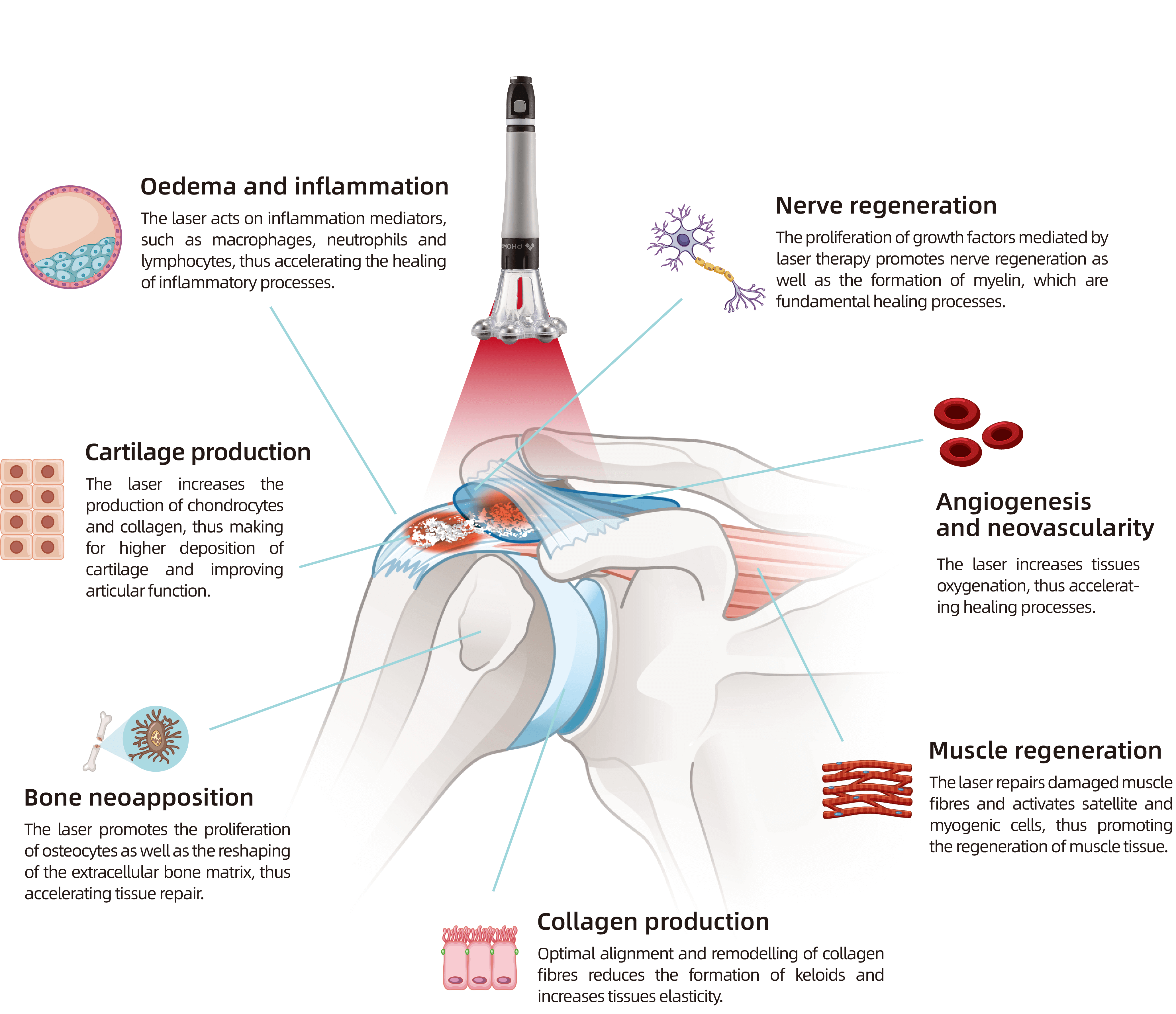
How laser light interacts with injured tissue at the cellular level
Reduces Inflammation
Laser light affects inflammatory cells directly, which can help calm swelling and speed the healing of inflamed tissue.6
Improves Blood Flow
Laser therapy can increase circulation to the treated area, helping deliver more oxygen and nutrients to support healing.1
Supports Nerve Function
Research suggests laser therapy may support nerve tissue repair, which is relevant for conditions like sciatica where a nerve is irritated or compressed.2
Aids Muscle & Tissue Repair
By boosting cellular energy production, laser therapy may help muscle and connective tissue repair itself more efficiently.1,2
What Laser Therapy Can Help With
Laser therapy is used for a wide range of conditions affecting muscles, joints, and nerves throughout the body.
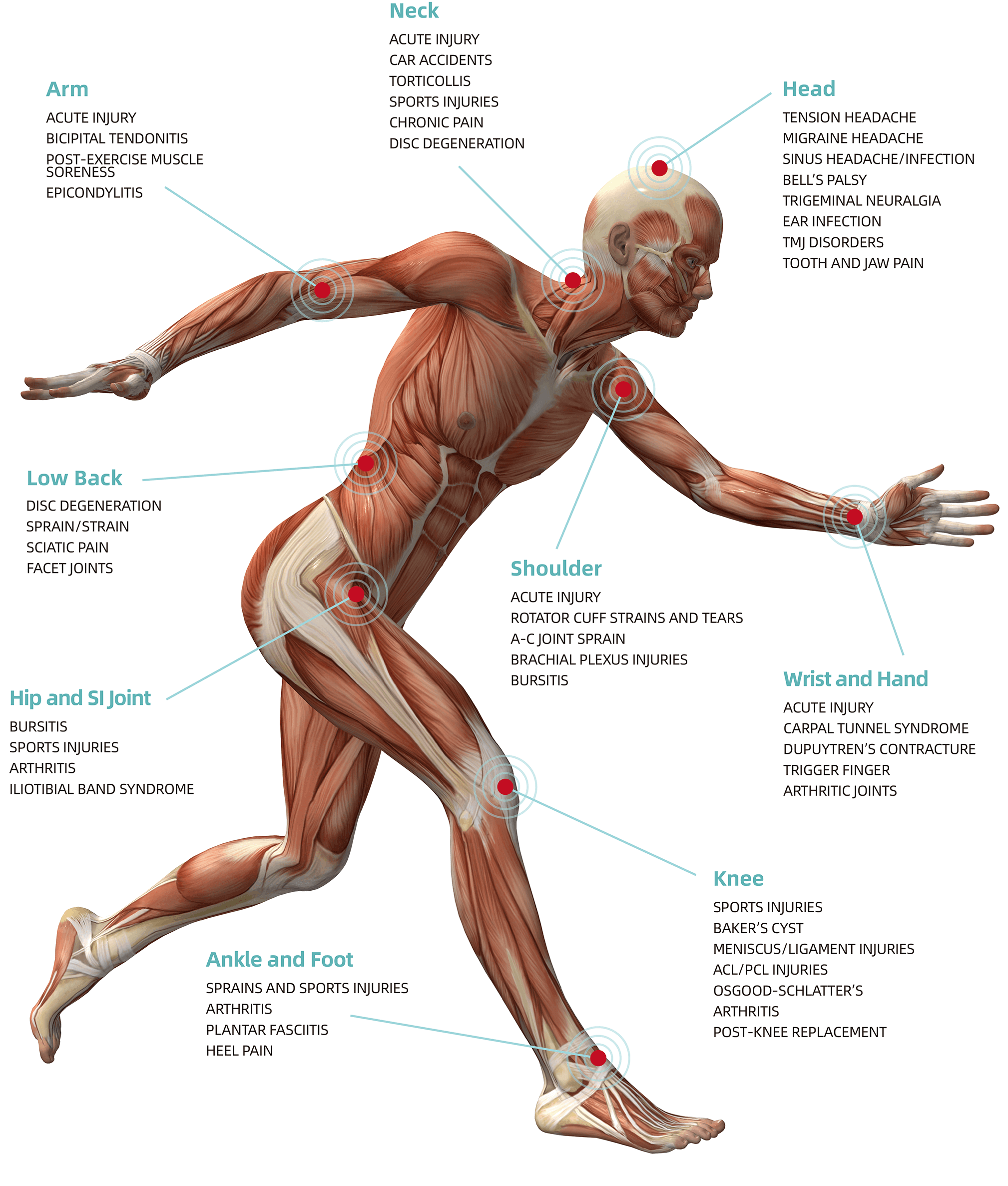
Neck & Back Pain
Disc-related pain, sprain/strain, sciatica, and facet joint irritation.
Sciatica
Targets inflammation and irritation affecting the sciatic nerve.
Shoulder Pain
Rotator cuff strain, bursitis, and A-C joint sprain.
Knee Pain
Osteoarthritis, ligament injuries, and general chronic discomfort.
TMJ & Jaw Pain
Inflammation and muscle tension in the jaw joint — see below.
Headaches
Tension headaches and migraine-related muscle tension.
Neuropathy
Nerve-related tingling, numbness, and discomfort.
Plantar Fasciitis
Heel pain and inflammation of the plantar fascia.
Carpal Tunnel & Wrist Pain
Nerve compression and inflammation in the wrist and hand.
Frozen Shoulder
Stiffness and restricted motion in the shoulder joint.
Hip & SI Joint Pain
Bursitis, arthritis, and iliotibial band-related discomfort.
Tendonitis
Inflammation of tendons from overuse or injury, including epicondylitis.
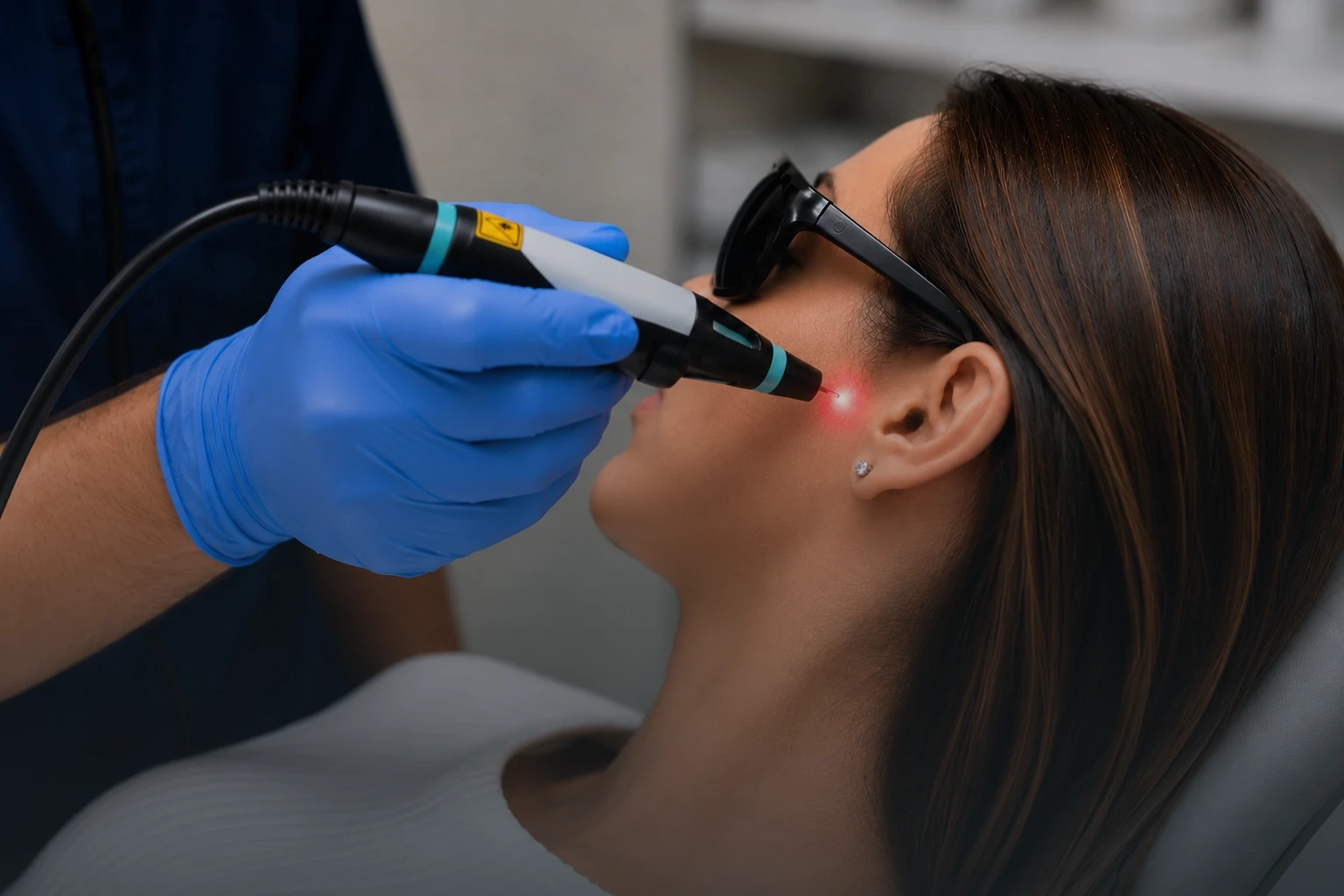
Class IV laser applied near the jaw joint for TMJ treatment
Laser Therapy for TMJ & Jaw Pain
Jaw pain from temporomandibular disorders (TMD) is one of the conditions we see most often, and laser therapy is one tool we use to help. Multiple systematic reviews and meta-analyses of randomized controlled trials have found that low-level laser therapy can meaningfully reduce jaw pain and improve function in people with TMD.7,8,9
One 2025 systematic review of 44 randomized controlled trials found that laser therapy reduced pain scores by 60–70% in TMD patients, and performed comparably to other common treatments in several studies.7 An earlier meta-analysis of 31 randomized trials similarly found positive effects on pain relief.8
Worth noting honestly: most of the published research on laser therapy for TMJ has used lower-power (Class III) lasers rather than Class IV specifically, since Class IV devices are a newer and less-studied category overall. Based on how photobiomodulation works, the deeper tissue penetration of Class IV should offer at least comparable benefit — but we want to be upfront that most published TMD-specific trials were done with less powerful devices.
For a deeper dive into TMJ-specific laser therapy, including more of the research and how it's used specifically for jaw pain, our sister site Oregon TMJ has a dedicated resource:
Read: Class IV Therapeutic Laser for TMJ Pain — Oregon TMJ →Is Laser Therapy Right for You?
Laser therapy is painless — most patients feel a gentle warmth during treatment, and there's no downtime afterward. Sessions are quick, and treatment plans vary based on your specific condition and how deep the affected tissue is. Dr. Segal will discuss what to expect for your specific situation after your evaluation.
Laser therapy is often used alongside chiropractic adjustments and other conservative care, rather than as a standalone treatment — giving your body multiple tools to support healing at once.
3. Class IV Therapy Lasers Maximize Primary Biostimulative Effects — MedCentral
4. FDA laser hazard classification system (21 CFR 1040.10) — Class IIIB lasers limited to 500 milliwatts; Class IV lasers exceed 500 milliwatts.
5. What Do the Laser Classifications Actually Mean? — Companion Animal Health
6. Hamblin MR. AIMS Biophysics, 2017 (anti-inflammatory mechanisms).
Frequently Asked Questions
Is Class IV laser therapy the same as red light therapy?
No. Red light therapy devices, including most at-home panels, are far lower power — typically under 500 milliwatts — and are classified as Class 3B or lower by the FDA. Class IV lasers exceed 500 milliwatts of power, often reaching several watts, which allows the light to penetrate deeper into tissue like muscles, joints, and nerves, rather than mostly affecting the surface of the skin.
Does laser therapy hurt?
No. Laser therapy is painless. Most patients feel a gentle, soothing warmth during treatment. There are no needles, no incisions, and no downtime afterward.
How many laser therapy sessions will I need?
This varies by condition, how long you've had symptoms, and how deep the affected tissue is. Dr. Segal will discuss a recommended plan with you after your evaluation, based on your specific situation.
Is laser therapy covered by insurance?
Most health insurance plans do not currently cover laser therapy. Many of our patients choose to pay for treatment themselves because of the results they experience, and we've worked to keep our per-treatment pricing accessible. Our office can help you understand your specific coverage before starting treatment.
Can laser therapy help with TMJ pain?
Research on low-level laser therapy for temporomandibular disorders (TMD) has shown positive effects on jaw pain and function in multiple systematic reviews and meta-analyses. Laser therapy is one tool that may help reduce inflammation and discomfort in the jaw joint and surrounding muscles.
Ready to Find Out If Laser Therapy Can Help You?
Call, text, or book online — we're happy to talk through your symptoms and whether laser therapy fits your care plan.
Disclaimer: This page is for general educational purposes and is not a substitute for professional medical evaluation. Laser therapy does not guarantee specific outcomes, and results vary by individual and condition. Coverage varies by insurance plan and policy. This page does not replace evaluation by a qualified healthcare provider.